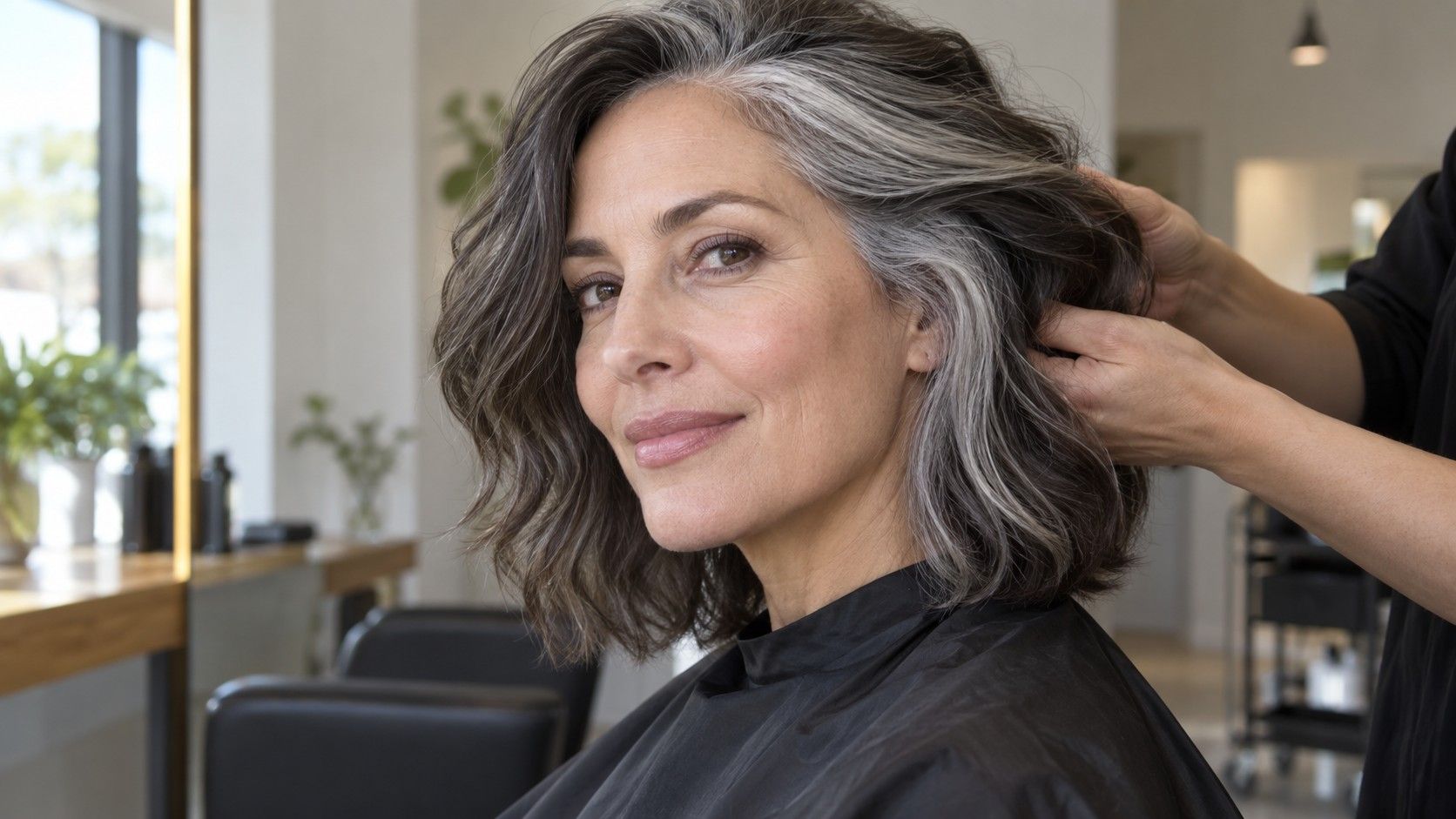
A fresh root color can look even through the part and still leave a bright silver outline at the temples. That contrast is easy to read as a failed dye job, but the cause is not always weak color. The hairline may have a different proportion and texture of gray, the chosen product may be designed to blend rather than cover, or the application may simply have been too light in the hardest-to-see area. Before coloring again, it helps to work out which of those problems you are actually looking at.
First decide whether you want solid coverage or a softer blend
Gray coverage and gray blending are different finishes. Opaque coverage aims to make white strands read close to the surrounding pigmented roots. Blending leaves some brightness and variation so the grow-out line is less abrupt. Both can be intentional, but they do not look the same at the hairline, where even a narrow group of white strands sits next to skin and catches direct light.
Check whether the chosen product is meant to cover gray
Look at the temples in indirect daylight after the hair is clean and dry. If each strand is tinted but still lighter than the rest, the color may have created a translucent blend. If some strands remain distinctly white while their neighbors are colored, the issue is more likely incomplete contact or uneven saturation. A glossy reflection can make a pale strand appear uncovered in a bathroom mirror, so compare both sides and move the hair rather than judging one bright photograph.
| What you see | Likely interpretation | Useful next question |
|---|---|---|
| Gray is softened but still visible | Translucent blending | Did you expect natural dimension or fully opaque coverage? |
| Scattered white strands among colored roots | Uneven contact or saturation | Were very small sections coated on both sides? |
| Both temples are lighter in the same way | Product or shade may be giving limited opacity | Does the label specifically describe gray coverage? |
| One temple is noticeably brighter | Application order, lighting, or access may differ | Was that side applied last or harder to reach? |
This distinction matters because repeated permanent color is a poor diagnostic tool. If the result is simply more translucent than you wanted, putting the same product on again may deepen the surrounding hair without making the gray behave differently. Define the finish first: bright strands softened into the roots, or white strands covered as evenly as the product can reasonably deliver.
Two boxes with similar shade names can have different purposes. A temporary color, color-depositing conditioner, sheer gloss, or some semi-permanent colors may change the cast of gray hair without providing opaque root coverage. A product described as permanent is not automatically a promise that every percentage and texture of gray will match the swatch. Read the coverage wording, the intended starting shades, and the instructions for gray hair rather than relying on the photograph on the front.
The shade choice also affects how visible the result feels. Very cool or fashion-forward tones can appear more transparent on white strands than a balanced, natural-looking shade at the same depth. That does not mean adding an arbitrary warm color is the answer. It means the target, the product line, and the amount of gray need to be considered together. If you are using a salon formula, ask what level of opacity it was designed to give. If you are using a retail kit, stay within its stated use and do not change the developer, mixing ratio, or processing time.
Coverage claims also have limits. A hairline made mostly of white strands will not behave visually like a parting with only a few scattered grays. The result may be technically colored yet still appear lighter because there is little naturally dark hair between the strands. Comparing the temple only with the darkest section of the root can create an impossible standard; compare it with another area that has a similar gray percentage.
Uneven saturation often starts with the way the hairline is sectioned
The temple looks like a small area, but it contains short hairs, fine flyaways, curves around the ear, and strands that spring away from the head. A broad brush stroke can coat the surface while leaving the underside of several white hairs untouched. Thick sections make this worse. When the hair is lifted after processing, those missed strands form the familiar silver line even though plenty of product was used nearby.
Fine sections make it easier to see whether color actually surrounds the resistant gray hair at temples. The goal is controlled, complete contact, not scrubbing the scalp or piling on a heavy mound that slides onto the face. Work only as directed by the product instructions, keep the hairline visible, and check that short strands have not folded out of the section. A barrier cream placed carelessly on the hair itself can also interfere with contact, so skin protection belongs on the skin rather than through the roots.
Application order can explain a one-sided result. People often begin at the part, move around the head, and reach the second temple near the end. If the instructions define the processing period from a particular point, follow that method consistently; do not improvise extra time for the hairline. Note which area was started first and whether the brighter temple was applied last. That observation is more useful for the next service than guessing that the whole head is unusually resistant.
Product residue and styling habits can add another variable. Dense wax, edge-control products, dry shampoo, or heavy skin care along the hairline may make neat saturation harder. Hair should be prepared exactly as the color instructions specify. Do not aggressively scrub the scalp immediately before coloring to chase a cleaner surface, and do not use unlisted pretreatments in an attempt to open the hair. A calm, repeatable setup gives a clearer result than stacking home fixes.
Protect the lengths while correcting a narrow root problem
When hair dye is not covering the gray hairline, the obvious temptation is to repaint everything. That can create a second problem: the previously colored lengths absorb more pigment, become darker or flatter, and collect unnecessary exposure while the two-centimeter temple area remains the real concern. Root coverage should stay focused on new growth unless the product directions or a planned professional service say otherwise.
Overlap is easy to miss at the sides because the hair is short and the boundary between new growth and old color is not perfectly straight. Use the mirror to locate the untreated root instead of dragging color down the sideburn and over the ends. If the lengths need a separate refresh, that is a different decision from solving resistant gray. Combining both decisions in one hurried application makes it hard to tell why the final shade changed.
Wait to assess the result until the hair is fully dry and viewed in stable light. Wet hair looks darker, and a freshly styled hairline can hide or expose different strands. Take a simple photo of each temple under the same window light and note the product, shade, date, and where application began. This is not about building a complicated color diary; it is enough information to stop the next attempt from being another guess.
Know when the coverage pattern needs a colorist’s assessment
If the same white strands remain untouched after careful use of a product intended for gray coverage, bring the pattern to a colorist rather than repeatedly extending time or increasing strength at home. Show the temples in natural light and explain whether you want full coverage or softer blending. Mention previous permanent color, any reactions, how often you retouch, and which areas fade first. A clear history lets the colorist plan around the hairline without treating all of the hair as one uniform surface.
A professional may evaluate the gray percentage, the contrast between the temple and the rest of the roots, and how porous the previously colored hair has become. They can also separate an application problem from a target-shade problem and discuss whether a more dimensional result would grow out better. That conversation is more useful than asking for a universal resistant-gray formula, because the workable approach depends on the product system and the hair already present.
For marked burning, localized swelling, blistering, or another significant irritation, stop coloring and seek medical advice. For breathing difficulty, sudden swelling of the mouth, throat, or tongue, or faintness, call 911 immediately. Coverage disappointment is cosmetic; a reaction is a safety issue. Follow patch-test and allergy instructions every time they are required, even if the shade has been used before. For ordinary uneven coverage, patience and a precise diagnosis usually protect the hair better than an immediate second round of permanent dye.